
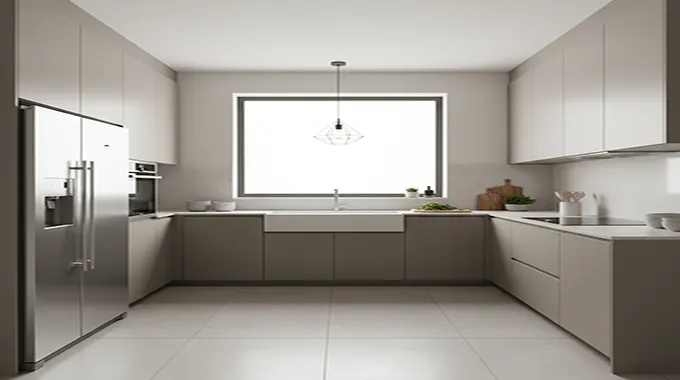
The kitchen is the heart of the home, and its layout is the foundation of its functionality. Choosing the right “kitchen set layout”—the arrangement of your cabinets, appliances, and countertops—is crucial for an efficient workflow, optimal storage, and creating a space you love.
Here is a step-by-step guide and an overview of the most common layouts to help you design your perfect culinary space.
1. Start with the “Kitchen Work Triangle”
The most fundamental concept in kitchen design is the Work Triangle, which connects the three main work stations:
- The Refrigerator (Storage)
- The Sink (Cleaning)
- The Stove/Cooktop (Cooking)
A well-designed layout minimizes the distance between these three points, creating an efficient flow.
- The Rule: The sum of all three sides of the triangle should ideally be between 4 metres (13 ft) and 7.9 metres (26 ft). No single leg should be less than 1.2 metres (4 ft) or more than 2.7 metres (9 ft).
- Purpose: To prevent unnecessary steps and improve the overall experience of prepping, cooking, and cleaning.
2. Assess Your Space and Lifestyle
Before looking at specific layouts, you must answer two key questions:
A. What are your Spatial Constraints?
- Measure Everything: Get the precise dimensions of your room, including the location of windows, doors, and existing utility hookups (plumbing, gas, electrical).
- Consider Traffic: Note the paths people take through the kitchen to other parts of the house. The layout should not obstruct these routes, especially the main work triangle.
B. What is your Cooking Style and Household Size?
| Lifestyle Factor | Layout Preference |
| Small Space/Single Cook | One-Wall, Galley, or small L-Shape. |
| Heavy Cooking/Multiple Cooks | U-Shape, Island, or G-Shape (Peninsula). |
| Frequent Entertaining/Open Concept | L-Shape with Island, or Open Concept. |
| Need Maximum Storage | U-Shape or G-Shape. |
3. Compare the Standard Kitchen Set Layouts
Kitchen layouts fall into six basic configurations, each with distinct pros and cons based on space and use.
1. The L-Shape Kitchen
- Description: Cabinets and appliances line two perpendicular walls.
- Best For: Small to medium-sized spaces.Creates a natural work triangle and is highly versatile.
- Pros: Open layout; ideal for adding a dining nook or island in a larger space; excellent traffic flow.
- Cons: Corner cabinets can be tricky; the work triangle can become too spread out in a very large L-shape.
2. The U-Shape Kitchen
- Description: Cabinets and appliances line three continuous walls, forming a ‘U’.
- Best For: Medium to large spaces; households with multiple cooks.
- Pros: Maximum counter space and storage; highly efficient work triangle; closes off the work zone from traffic.
- Cons: Can feel enclosed or dark in small spaces; requires careful planning to avoid feeling cluttered.
3. The Galley Kitchen (Parallel)
- Description: Two straight runs of cabinets and appliances face each other, with a corridor in between.
- Best For: Narrow spaces; small apartments; single, efficient cooks.
- Pros: Extremely efficient workflow (everything is within easy reach); cost-effective due to simple design.
- Cons: Can become a crowded thoroughfare if it’s a main pathway; limited space for multiple cooks.
4. The One-Wall Kitchen (Straight Line)
- Description: All components are placed along a single wall.
- Best For: Small studios, loft apartments, or areas where space is severely restricted.
- Pros: Most space-efficient; provides an open, spacious feel; often the lowest cost.
- Cons: Very limited counter and storage space; the work triangle is a straight line, which can be less efficient for serious cooking.
5. Kitchen with Island or Peninsula
- Description: Typically an L- or U-shape with a central fixed island or a peninsula (an island attached to a wall).
- Best For: Large, open-plan homes; social cooks/entertainers.
- Pros: Adds massive countertop and storage area; creates a social hub for seating; excellent division of zones.
- Cons: Requires substantial floor space (at least 1.2 metres (4 ft) clearance around the island is recommended); the most expensive option.
Final Kitchen Layout Checklist
- Functionality: Does the layout support the Work Triangle and the way you cook?
- Clearance: Do you have enough space (at least 1 metre (3 ft)) to fully open all appliance doors (dishwasher, oven, fridge) without blocking the flow?
- Storage Zones: Have you placed your cooking utensils near the stove, dishes near the dishwasher/sink, and prep tools near the main counter space?
- Aesthetics: Does the layout complement the rest of your home’s style and the overall feel you want to achieve (e.g., open, cozy, modern)?
By systematically considering your available space, your lifestyle needs, and the pros and cons of the standard layouts, you can confidently choose a kitchen set design that transforms your cooking experience.?

